Spokane, WA
Garage Door Cable and Roller Repair in Spokane
One cable slack, one taut, and the door sitting crooked. Cables carry the door's whole weight to the spring, so this one does not wait.
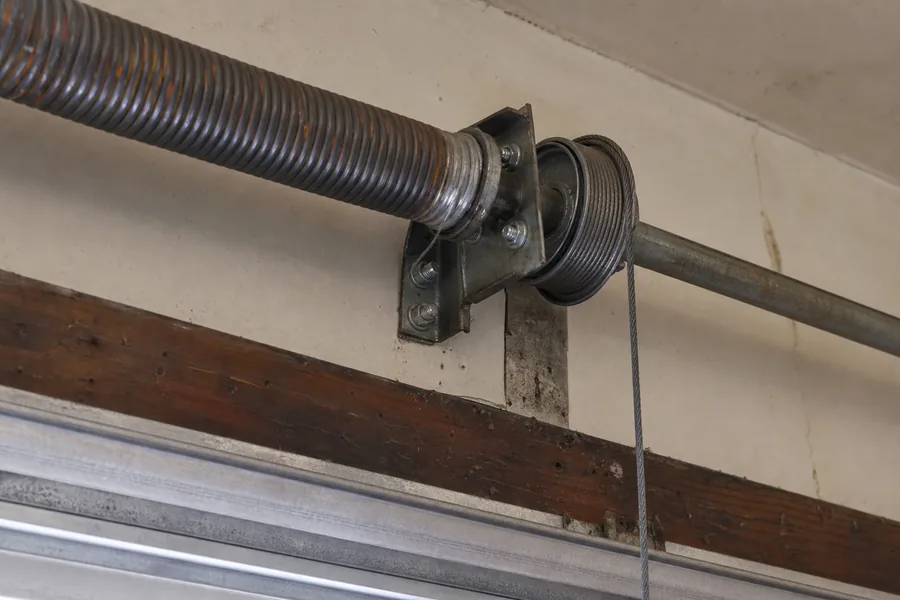
One cable slack, one taut, and the door sitting crooked. Cables carry the door's whole weight to the spring, so this one does not wait.
A snapped cable or seized roller is the fault we are called out for most often in Spokane, and it is the one homeowners least expect. Nothing wears visibly, nothing sounds wrong, and then one morning the door will not lift and the car is shut in. Around South Hill and North Side we see it concentrated in pre-war craftsman homes with detached garages and newer north-side builds, where deep freezes snap cold-shortened springs and freeze doors to the slab.
Two cables run from the bottom brackets, up the sides, and wind onto drums at each end of the torsion shaft. They are what actually carries the door's weight to the spring. If one lets go, the door drops on that side, jams in the track and comes off the rails - which is why a cable failure and an off-track door usually arrive as one call.
Spokane, Spokane Valley, Cheney, Liberty Lake and the rest of Spokane County are all inside the normal radius. The visit costs nothing, the written estimate costs nothing, and the price is fixed before a tool comes out.
A cable warns you before it goes. Run your eye along its length: broken strands stand out from the lay of the wire like whiskers, usually near the bottom. Compare the two sides - one slack while the other is tight means a cable has already slipped its drum. And if the door has started closing crooked, it is past the warning stage.
If any of that matches, a technician can diagnose it on site in about ten minutes. We do not guess at it down the phone, and we do not charge to look.
Lift cables are galvanized steel and they last as long as the surface stays intact. The bottom bracket end sits closest to the damp floor, so that is where they rust, and that is where they fray first. Rollers are a shorter story: builder-grade plastic rollers with no bearings are done in five to seven years.
Cables go back in pairs. They have carried identical loads for identical years, and the drums have to be set equally or the door will sit permanently a little out of square. While it is apart, sealed-bearing nylon rollers are the upgrade actually worth paying for - quieter, far less drag on the track, and several times the life of the plastic ones.
A roller that has seized takes the track with it, so a roller replacement that is left too long turns into a track repair. If we are already there for a cable, changing the rollers at the same time costs the parts and almost no extra labor.
People put this off, and it is worth being straight about where that goes. None of the following is unusual - it is the ordinary sequence, and we see it in Spokane every week.
The visit and the written estimate are free, so finding out where you stand costs you nothing at all. That is the whole reason to call early rather than late.
Less than the industry likes to imply. Torsion hardware is torsion hardware, and a spring, a cable and a roller are the same components whoever stamped the panel. Where the brand does matter is parts availability and a handful of proprietary designs.
| Brand | Notes |
|---|---|
| LiftMaster / Chamberlain | The same units under two names. Gear kits, logic boards and Security+ 2.0 remotes are stocked, and the older 315MHz heads can still be paired. |
| Overhead Door / Raynor | Standard torsion hardware on the residential lines - nothing unusual to source. |
| Wayne Dalton | The TorqueMaster counterbalance is a spring inside the tube rather than on it, and it needs its own tools and its own parts. We carry them. |
| Amarr | Sections and hardware are widely available and the tracking is standard, which keeps repair costs sensible. |
| Craftsman | Built on Chamberlain internals for most of their production run, so the gear kits and boards are shared and readily available. |
| Sommer / Marantec | Less common here, direct-drive heads, and the parts have to be ordered - so we confirm the model before the van is loaded. |
Not listed is not a problem. Residential doors are overwhelmingly standard hardware, and the handful that are not are identified from the model number in about ten seconds on the phone.
Spokane is the base and the surrounding towns are within the normal working radius. These are the areas the van is in most days:
Emergency and after-hours calls run to the same map. A door standing open overnight anywhere on that list gets somebody out.
The bottom bracket is the one fitting on a garage door that carries the entire spring load, and on most doors there is a warning label on it saying so. Undo that bolt with the counterbalance still wound and the whole system releases at once, through whatever is in the way. This is not a cautious-and-you-will-be-fine job.
Doing nothing is genuinely the right move here, which is not advice people are used to getting. A door that has already failed does not deteriorate sitting still; it deteriorates every time somebody presses the button to see whether it is still broken.
The one exception is getting a car out. Release the opener with the door fully closed, lift with your legs, and stop immediately if it feels heavy - heavy means the counterbalance is not working and the door will come back down on its own.
The difference between a job finished today and a job finished on Thursday is almost always whether the right part was on the van when it arrived. So the van is loaded for what Spokane actually breaks rather than for a national average.
Springs in the common sizes, lift cables, drums, rollers, hinges, brackets, opener gear kits, remotes, safety sensors and weather seal all travel with the technician. Panels and complete doors are ordered, and we tell you that at the estimate rather than on the day.
It is also why the description you give on the phone matters. Tell us what the door is doing, what it sounds like, whether it is a single or a double and roughly how old it is, and the van leaves already carrying the answer.
Deep freezes snap cold-shortened springs and freeze doors to the slab. Put that against a mechanism made of wound steel, galvanized cable and nylon bearings and the outcome is not mysterious.
Corrosion is the quiet one. A spring that has picked up surface rust has lost section where the rust sits, and stress concentrates exactly there. It does not squeak or warn you - it simply fails earlier than its cycle count says it should.
Temperature is the loud one. Steel is a little less forgiving cold than warm, so a spring at the end of its life picks the coldest morning of the month to go. That is why the phone in Spokane County rings hardest before eight.
Neither is a reason to buy a different door. It is a reason to service the one you have before the season that will break it, and to size the replacement parts for Spokane rather than for a catalog.
Deep freezes snap cold-shortened springs and freeze doors to the slab. Split by component, the effect is not evenly distributed:
| Part | What the local climate does to it |
|---|---|
| Torsion spring | Surface corrosion removes section, stress concentrates there, and the spring fails short of its cycle rating. |
| Lift cables | Rust starts at the bottom bracket end, closest to the floor, and works up the lay of the wire. |
| Rollers | Grit and moisture together destroy unsealed bearings; sealed nylon rollers are largely immune. |
| Bottom seal | Hardens, cracks, and stops sealing - after which the weather is inside the garage rather than outside it. |
| Opener | Suffers indirectly. Every one of the above makes the door heavier to move, and the nylon drive gear is what pays for it. |
None of it is exotic and none of it needs a special product. It needs looking at twice a year, which is the part most people in Spokane skip.
Spokane covers South Hill and North Side. Not a franchise territory drawn on a map somewhere else - the actual streets the van is on most days.
You get a two-hour arrival window rather than a day, and a call before the technician sets off. If we are going to be late you hear it from us first.
The visit is free, the written estimate is free, and nothing is agreed until you have seen it in writing. If you decide against it, that is the end of it.
Usually, yes. We hold same-day slots for Spokane and the surrounding towns, and a door stuck open or a car shut in goes to the front of the list.
If a spring or cable has failed, no. Leave it down and do not force it. The counterbalance holds a great deal of stored energy and it can let go without warning.
No. The visit and the written estimate are free anywhere in Spokane County. You pay only if you agree the price and we do the work.
Yes - Spokane Valley, Cheney, Liberty Lake and the wider Spokane County area are all inside our normal service radius.
Yes, in writing, on parts and labor. If the same fault returns inside the warranty period we come back and put it right at no charge.
A roller that has stopped turning does not stay a roller problem. It drags, and what it drags is the track, so a small part left too long becomes a track section and a realignment. If the van is already there for a cable, the rollers cost parts and almost no extra labor.
One call gets you a two-hour arrival window rather than a day, and a technician who rings before setting off. No lead auction, no bidding, no stranger quoting your door by phone.
Free visit, free written estimate, fixed price agreed before anything is touched. Throughout Spokane and Spokane Valley, Cheney, Liberty Lake.
A two-hour window rather than a day, and a call before the technician sets off. Free throughout Spokane County, with nothing to pay if you decide against the quote.
Prefer to talk it through? Call (509) 355-1344.
One flat bang overnight and the door will not lift. The spring is what cancels the door's weight, and when it goes the opener cannot take over.
What this costs and how fast →Four faults cover almost all of it - photo eyes, drive gear, limit switch, logic board. Three of the four are a part and an hour.
What this costs and how fast →Rollers reseated, hinges checked for the damage a derailment hides, and the track trued against a level. Then we find what put it there.
What this costs and how fast →The fault is ordinary - a spring, a cable, a derailed door. What makes it urgent is what it has trapped. Secured first, repaired second.
What this costs and how fast →Insulation is the specification you notice daily: R-0 to R-2 bare, R-6 to R-9 polystyrene, R-12 to R-18 polyurethane. Stiffer and much quieter.
What this costs and how fast →